Screening:
Karanlık Dünya / Âşık Veysel'in Hayatı [Dark World / The Life of Âşık Veysel]
Salt Beyoğlu
September 27 – December 6, 2025
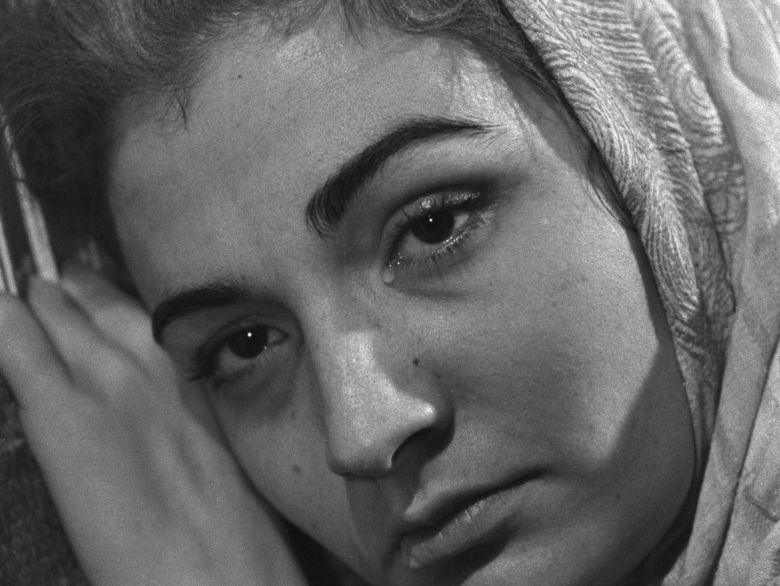
Still from Karanlık Dünya / Âşık Veysel’in Hayatı [Dark World / The Life of Âşık Veysel] (1953)
©Atadeniz Film
©Atadeniz Film
Walk-in Cinema
Based on extensive research by artist Mike Bode and screenwriter Caner Yalçın, the exhibition Dark World at Salt Galata investigates the intricate story of the film of the same title, situating it within the cultural landscape of 1950s Turkey. Presented within the framework of the exhibition, the film, directed by Metin Erksan and written by Bedri Rahmi Eyüboğlu, will be screened in the Walk-in Cinema at Salt Beyoğlu at scheduled times.
Shot with a social realist perspective in the village of Sivrialan (Sivas) and the town of Ürgüp (Nevşehir), the film portrays the life of Âşık Veysel, from his childhood to his emergence as a renowned folk poet, intertwined with a melodramatic love story. Yet the film’s narrative takes an unexpected turn after parts of the film were remade to align with the agricultural development and rural modernization policies of the period. The footage of combine harvesters in the Hudson fields—sourced from the United States Information Service, according to Erksan—along with constructed scenes of a village school and dispensary allegedly filmed on the outskirts of Istanbul, were used to present an idealized image of rural life. These additions sidelined Veysel’s life story and transformed the film into a vehicle for propagating official ideology. Among the reasons behind this shift are the censorship rulings issued by the Central Film Control Commission in Ankara, documented in three reports dated between December 1952 and November 1953. Following edits made by the producer, Atlas Film, the reworked version was eventually premiered on December 31, 1953, under the title Âşık Veysel’in Hayatı [The Life of Âşık Veysel]. The production process, commercial interests, and ideological tensions turned the film into an eclectic work whose entire character shifted in tandem with its title.
What remains of the film today is a disjointed montage, deleted or added scenes, audio disruptions, and narratives built around them. The pre-censored cut and the premiered version are still unknown, while the copies in circulation differ somewhat in sound, image, and editing. Adding to this fragmented legacy is a 35mm nitrate print, recently discovered in the archive of Mimar Sinan Fine Arts University (MSGSÜ) Prof. Sami Şekeroğlu Cinema and Television Center, which includes footage unearthed for the first time. Among them are scenes of wheat fields—often referenced in interviews and oral histories as having been removed due to the perceived weakness of the crops. The footage also includes a cave and church scene in which the character Dilim, upon encountering a defaced fresco of Jesus, is reminded of Âşık Veysel—a moment explicitly cited by Erksan as having been left out of the original cut. Other segments depict narrative scenes set in Cappadocia, various landscape shots, and an extended wedding sequence focusing on everyday village life.
The screening will present the version as preserved by Atadeniz Film utilizing the unrestored scan of the film along with footage uncovered from MSGSÜ’s archive. The film will be shown in its original language.
Dates:
Saturday, 27 September, 17.00
Thursday, 16 October, 19.00
Thursday, 6 November, 19.00
Saturday, 6 December, 17.00
Based on extensive research by artist Mike Bode and screenwriter Caner Yalçın, the exhibition Dark World at Salt Galata investigates the intricate story of the film of the same title, situating it within the cultural landscape of 1950s Turkey. Presented within the framework of the exhibition, the film, directed by Metin Erksan and written by Bedri Rahmi Eyüboğlu, will be screened in the Walk-in Cinema at Salt Beyoğlu at scheduled times.
Shot with a social realist perspective in the village of Sivrialan (Sivas) and the town of Ürgüp (Nevşehir), the film portrays the life of Âşık Veysel, from his childhood to his emergence as a renowned folk poet, intertwined with a melodramatic love story. Yet the film’s narrative takes an unexpected turn after parts of the film were remade to align with the agricultural development and rural modernization policies of the period. The footage of combine harvesters in the Hudson fields—sourced from the United States Information Service, according to Erksan—along with constructed scenes of a village school and dispensary allegedly filmed on the outskirts of Istanbul, were used to present an idealized image of rural life. These additions sidelined Veysel’s life story and transformed the film into a vehicle for propagating official ideology. Among the reasons behind this shift are the censorship rulings issued by the Central Film Control Commission in Ankara, documented in three reports dated between December 1952 and November 1953. Following edits made by the producer, Atlas Film, the reworked version was eventually premiered on December 31, 1953, under the title Âşık Veysel’in Hayatı [The Life of Âşık Veysel]. The production process, commercial interests, and ideological tensions turned the film into an eclectic work whose entire character shifted in tandem with its title.
What remains of the film today is a disjointed montage, deleted or added scenes, audio disruptions, and narratives built around them. The pre-censored cut and the premiered version are still unknown, while the copies in circulation differ somewhat in sound, image, and editing. Adding to this fragmented legacy is a 35mm nitrate print, recently discovered in the archive of Mimar Sinan Fine Arts University (MSGSÜ) Prof. Sami Şekeroğlu Cinema and Television Center, which includes footage unearthed for the first time. Among them are scenes of wheat fields—often referenced in interviews and oral histories as having been removed due to the perceived weakness of the crops. The footage also includes a cave and church scene in which the character Dilim, upon encountering a defaced fresco of Jesus, is reminded of Âşık Veysel—a moment explicitly cited by Erksan as having been left out of the original cut. Other segments depict narrative scenes set in Cappadocia, various landscape shots, and an extended wedding sequence focusing on everyday village life.
The screening will present the version as preserved by Atadeniz Film utilizing the unrestored scan of the film along with footage uncovered from MSGSÜ’s archive. The film will be shown in its original language.
Dates:
Saturday, 27 September, 17.00
Thursday, 16 October, 19.00
Thursday, 6 November, 19.00
Saturday, 6 December, 17.00

