Upcoming Exhibition:
Across the Seas
Özer Kabaş and His Times
Salt Beyoğlu
September 16, 2026 – March 14, 2027
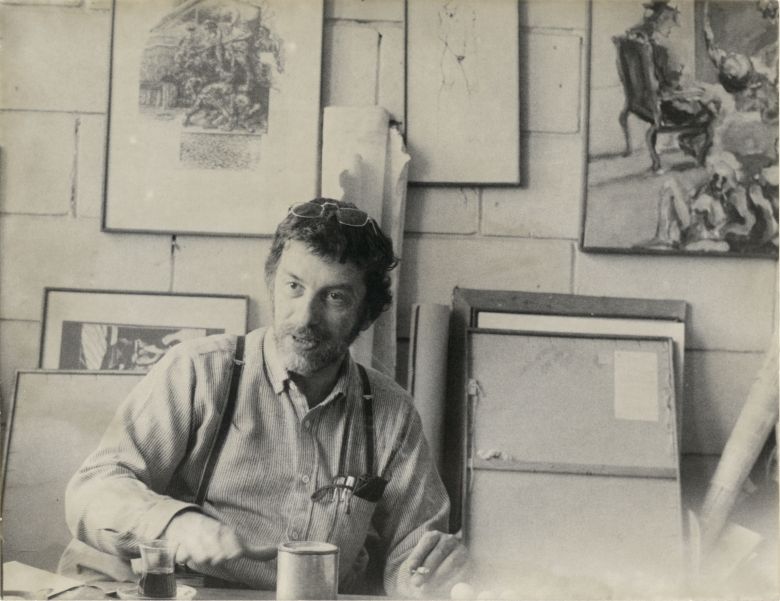
Özer Kabaş in his room at the State Academy of Fine Arts in Istanbul, approximately 1970s
Salt Research, Özer Kabaş Archive
Salt Research, Özer Kabaş Archive
Across the Seas: Özer Kabaş and His Times examines the practice of artist, educator, and writer Özer Kabaş (1934–1998)—ranging from painting and design to film and theater—and his place in Turkey’s cultural history.
Kabaş’s intellectual and artistic outlook was shaped at Robert College (Boğaziçi University), where he studied engineering, and at the Yale School of Art, where he studied painting from 1957 to 1962. This gave him a unique perspective combining structural analysis with freedom of expression.
While Kabaş is generally situated within the figurative tendencies in Turkey’s art scene, he maintained a critical distance from the polarizing approaches that positioned figuration in opposition to abstraction. In his view, what mattered was not the chosen style but the artist’s ability to develop a unique language rooted in geographical context and lived experience. Through concepts he developed in his writings, such as “montage,” “synthesis,” and “horizontal and vertical effects,” Kabaş explored the relationship between local visual culture and the global art scene. He rejected both the idea of tradition as something fixed and the uncritical adoption of Western art as a model. For him, art was shaped by the constant interaction of culture, history, geography, and everyday life. Alongside his painting and teaching, his short films, texts, and jewelry designs at the Urart Art Studio, which he co-founded, were part of the same intellectual quest.
From the 1970s onward, Kabaş focused on the sea, labor, and human relationships in his paintings. He rejected linear perspective, instead layering images on top of one another and surrounding them with nature. He placed maritime workers at the center of his compositions, with the sea enveloping the figures. The waves, the sky, and mythological creatures in his paintings reflected an animistic interpretation of nature. Narratives from Homer to Anatolian legends, along with coastlines, islands, and sea voyages, formed the conceptual foundation of his work, while the world of fishermen, sailors, and dockworkers offered a way to engage with broader historical and social contexts. The sea shaped his artistic practice, and painting became both a refuge from the burdens of daily life and a means for expression beyond the boundaries of language.
Kabaş taught at Robert College from 1964 to 1974 and helped develop the campus’s cultural environment as director of Social Hall and advisor to the Robert College Cinema Club. In 1971, he began teaching part-time at the Istanbul State Academy of Fine Arts (later Mimar Sinan University), where he joined the core faculty of the Basic Design Education Chair and introduced the Bauhaus methodology he learned from Josef Albers at Yale into the curriculum. Following the chair’s termination, he was appointed associate professor in the Department of Painting in 1985 and became a professor in 1990. He continued guiding many artists throughout his career until his passing in 1998.
Across the Seas: Özer Kabaş and His Times sheds light on the turning points in Kabaş’s artistic and academic practice from the 1960s to the 1990s. The exhibition features the artist’s paintings and original prints, alongside jewelry he designed at the Urart Art Studio, his 1967 film İstanbul Hatırası [Memory of Istanbul], the documentary he made with artist Altan Gürman on Marmara Island, and documents from his archive at Salt Research. These materials are accompanied by selected works of Mehmet Güleryüz, Fatma Tülin, and Sedat Pakay, whose paths crossed with Kabaş at different times. Spanning the second and third floors of Salt Beyoğlu, the exhibition highlights Kabaş’s interest in various artistic disciplines, his approach to art education, and his contributions to Turkey’s cultural landscape.
***
Program: Tuğçe Kaplan, Vasıf Kortun
Exhibition Assistant: İncila Pertev
Editor: Ezgi Yurteri
Exhibition Design and Production: Emirhan Altuner
Design and Production Assistant: Fulya Aras
Acknowledgments: Beril Anılanmert, Zeynep Atikkan, Mehmet Ayanoğlu, Bülent Becan, Boğaziçi University Cinema Club, Rabia Çapa, Cevat Çapan, Aytaç Demirci, Lütfi Ensari, Candeğer Furtun, Grey Art Museum, Mişel Grünberg, Kerimcan Güleryüz, Nathalie Güleryüz, Bülent Gültekin, Tülay Güngen, Hasan Gürdal, IMOGA, Ali Kabaş, Şefik Kabaş, Samed Karagöz, Gülsün Karamustafa, Zehra Begüm Kışla, Zeynep Miraç, Neslihan Muratbeyoğlu, Ahmet Özge, Elif Özge, Kathy Pakay, Robert College Archive, Cavit Sarıoğlu, Donald Spanel, Mustafa Taviloğlu, Taviloğlu Collection, Eda Tekcan, Süleyman Saim Tekcan, Zeynep Torkak, TRT, Ömer Tuncer, Fatma Tülin, Veysel Uğurlu, Saskia K. Verlaan, Michèle Wong, Yapı Kredi Culture and Arts
Across the Seas: Özer Kabaş and His Times is realized with the support of Serdar Erener and Leyla Tara and with contributions from Eureko Sigorta and Jotun. Salt acknowledges Yula Kabaş for loaning artworks and granting access to personal archives throughout the preparation of this exhibition.
Kabaş’s intellectual and artistic outlook was shaped at Robert College (Boğaziçi University), where he studied engineering, and at the Yale School of Art, where he studied painting from 1957 to 1962. This gave him a unique perspective combining structural analysis with freedom of expression.
While Kabaş is generally situated within the figurative tendencies in Turkey’s art scene, he maintained a critical distance from the polarizing approaches that positioned figuration in opposition to abstraction. In his view, what mattered was not the chosen style but the artist’s ability to develop a unique language rooted in geographical context and lived experience. Through concepts he developed in his writings, such as “montage,” “synthesis,” and “horizontal and vertical effects,” Kabaş explored the relationship between local visual culture and the global art scene. He rejected both the idea of tradition as something fixed and the uncritical adoption of Western art as a model. For him, art was shaped by the constant interaction of culture, history, geography, and everyday life. Alongside his painting and teaching, his short films, texts, and jewelry designs at the Urart Art Studio, which he co-founded, were part of the same intellectual quest.
From the 1970s onward, Kabaş focused on the sea, labor, and human relationships in his paintings. He rejected linear perspective, instead layering images on top of one another and surrounding them with nature. He placed maritime workers at the center of his compositions, with the sea enveloping the figures. The waves, the sky, and mythological creatures in his paintings reflected an animistic interpretation of nature. Narratives from Homer to Anatolian legends, along with coastlines, islands, and sea voyages, formed the conceptual foundation of his work, while the world of fishermen, sailors, and dockworkers offered a way to engage with broader historical and social contexts. The sea shaped his artistic practice, and painting became both a refuge from the burdens of daily life and a means for expression beyond the boundaries of language.
Kabaş taught at Robert College from 1964 to 1974 and helped develop the campus’s cultural environment as director of Social Hall and advisor to the Robert College Cinema Club. In 1971, he began teaching part-time at the Istanbul State Academy of Fine Arts (later Mimar Sinan University), where he joined the core faculty of the Basic Design Education Chair and introduced the Bauhaus methodology he learned from Josef Albers at Yale into the curriculum. Following the chair’s termination, he was appointed associate professor in the Department of Painting in 1985 and became a professor in 1990. He continued guiding many artists throughout his career until his passing in 1998.
Across the Seas: Özer Kabaş and His Times sheds light on the turning points in Kabaş’s artistic and academic practice from the 1960s to the 1990s. The exhibition features the artist’s paintings and original prints, alongside jewelry he designed at the Urart Art Studio, his 1967 film İstanbul Hatırası [Memory of Istanbul], the documentary he made with artist Altan Gürman on Marmara Island, and documents from his archive at Salt Research. These materials are accompanied by selected works of Mehmet Güleryüz, Fatma Tülin, and Sedat Pakay, whose paths crossed with Kabaş at different times. Spanning the second and third floors of Salt Beyoğlu, the exhibition highlights Kabaş’s interest in various artistic disciplines, his approach to art education, and his contributions to Turkey’s cultural landscape.
Program: Tuğçe Kaplan, Vasıf Kortun
Exhibition Assistant: İncila Pertev
Editor: Ezgi Yurteri
Exhibition Design and Production: Emirhan Altuner
Design and Production Assistant: Fulya Aras
Acknowledgments: Beril Anılanmert, Zeynep Atikkan, Mehmet Ayanoğlu, Bülent Becan, Boğaziçi University Cinema Club, Rabia Çapa, Cevat Çapan, Aytaç Demirci, Lütfi Ensari, Candeğer Furtun, Grey Art Museum, Mişel Grünberg, Kerimcan Güleryüz, Nathalie Güleryüz, Bülent Gültekin, Tülay Güngen, Hasan Gürdal, IMOGA, Ali Kabaş, Şefik Kabaş, Samed Karagöz, Gülsün Karamustafa, Zehra Begüm Kışla, Zeynep Miraç, Neslihan Muratbeyoğlu, Ahmet Özge, Elif Özge, Kathy Pakay, Robert College Archive, Cavit Sarıoğlu, Donald Spanel, Mustafa Taviloğlu, Taviloğlu Collection, Eda Tekcan, Süleyman Saim Tekcan, Zeynep Torkak, TRT, Ömer Tuncer, Fatma Tülin, Veysel Uğurlu, Saskia K. Verlaan, Michèle Wong, Yapı Kredi Culture and Arts
Across the Seas: Özer Kabaş and His Times is realized with the support of Serdar Erener and Leyla Tara and with contributions from Eureko Sigorta and Jotun. Salt acknowledges Yula Kabaş for loaning artworks and granting access to personal archives throughout the preparation of this exhibition.

